Product Overview
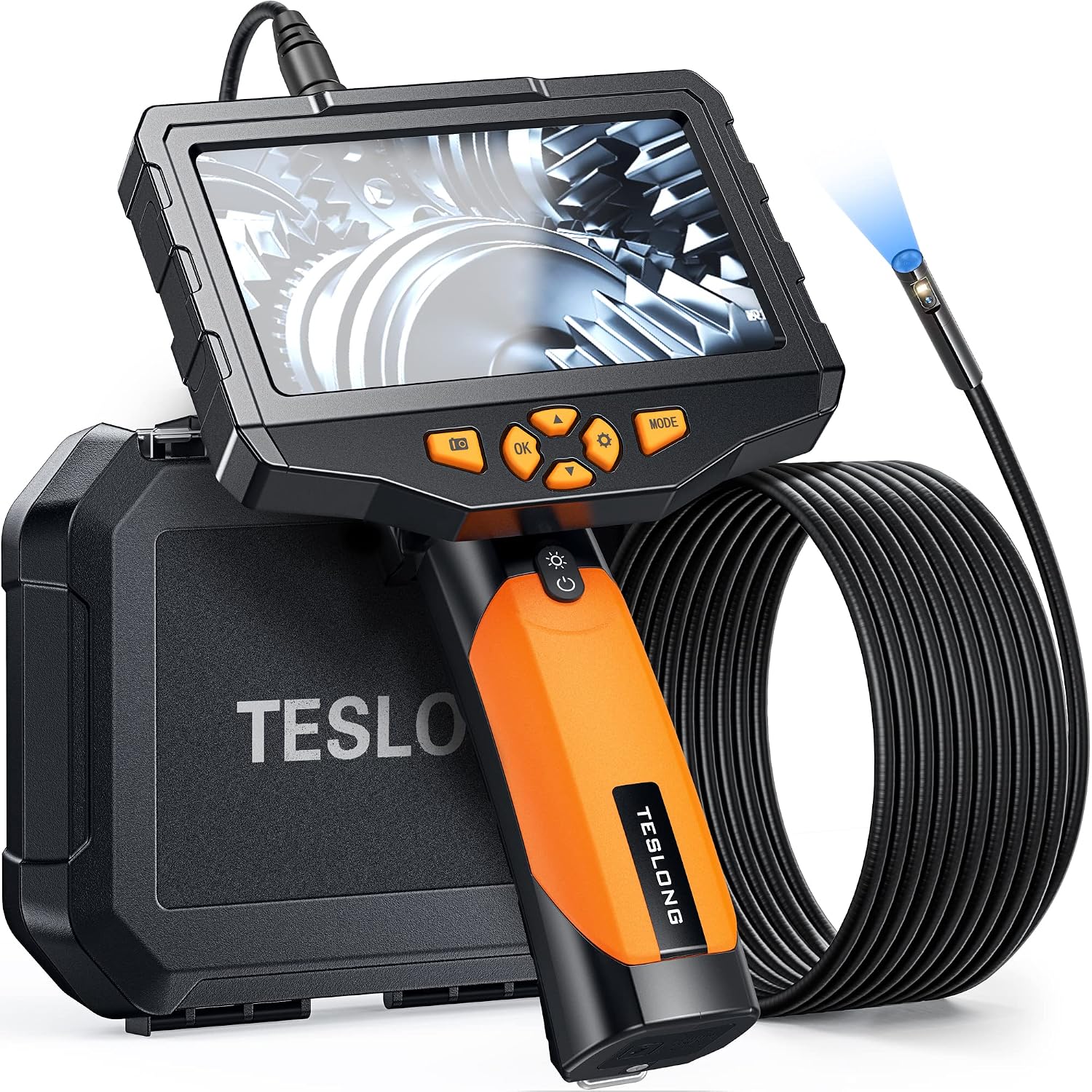
The Teslong 5'' Dual Lens Borescope Camera for Wall & Engine Inspection is identified with ASIN B07TV2BFVR as a Teslong NTS300 standalone inspection camera. Its core design combines a dedicated 5-inch monitor, a built-in rechargeable battery, a removable microSD card, and a long flexible probe rather than relying on a phone or tablet for viewing.
The ASIN-matching configuration is described by third-party product references as an 8 mm dual-lens model with a 16.5-foot, or approximately 5-meter, probe. Teslong’s current NTS300 family page confirms that 8 mm and 5-meter dual-lens options are part of the product family, although the manufacturer page presents several NTS300 variants and does not itself display this exact ASIN.
That distinction matters: the general NTS300 documentation supports many of the main product features, while the exact probe configuration is supported by ASIN-matching sources.
The camera is intended for visual inspection in spaces that are difficult to reach or view directly. Its stated applications include engine and car repair work, wall inspection, plumbing, HVAC maintenance, electrical installation, mechanical inspection, and other non-invasive checks through existing openings. A probe of this length can be useful when the inspection point is well inside a wall cavity, pipe, engine compartment, or machinery assembly, but the camera remains an inspection aid rather than a replacement for repair tools or professional diagnostic equipment.
Its main appeal is the combination of two viewing directions and a large built-in screen. The front camera looks ahead into the route of the probe, while the side camera looks across the adjacent surface. This can reduce the need to repeatedly withdraw and reposition the probe when the area of interest is beside the insertion path.
The system also supports still-image capture and video recording, giving users a way to document findings for later review or communication.
Key Features and Specifications
Display, imaging and recording
The NTS300 uses a 5-inch monitor with a manufacturer-listed display resolution of 854 x 480 pixels. Some third-party ASIN-matching listings describe the screen using different resolution language, including 720p or 1280 x 720, but the manufacturer specification is the stronger source for the display figure and is used here. The available evidence confirms that the screen is intended to provide a direct view from the probe without requiring a separate mobile device.
The camera can capture 1920 x 1080 still images and record 1280 x 720 video, according to Teslong’s NTS300 product information. These are capture and recording specifications, not the same thing as the monitor’s 854 x 480 display resolution. In practical terms, saved files may have a different resolution from the live image presented on the built-in screen.
Dual-lens viewing
The front-facing camera provides a straight view along the probe’s direction of travel. The second camera provides a side view, which is useful when inspecting walls of pipes, cylinder areas, engine components, ducts, or other surfaces that are not directly ahead of the probe tip. For the 8 mm probe, Teslong lists an approximately 78-degree field of view for both viewing directions.
The manufacturer lists a straight-viewing depth of field of approximately 1.18 to 3.15 inches and a side-viewing depth of field of approximately 0.79 to 1.97 inches. These figures describe the approximate distance range in which subjects can appear acceptably focused; they should not be interpreted as a promise that every object will look equally sharp throughout those ranges.
Probe lighting and monitor flashlight
The straight-viewing camera uses six adjustable high-intensity LEDs, while the side-viewing camera uses one adjustable high-intensity LED. Adjustable lighting is important inside dark cavities because bright illumination can help reveal surfaces, while reducing the intensity can help limit glare on reflective metal or wet areas.
The monitor also includes a 1-watt Cree LED flashlight. This is separate from the lights at the probe tip and can help illuminate the area around the operator, an access point, or nearby tools. The supplied information does not establish a particular brightness rating, beam distance, or runtime for the flashlight.
Power and storage
Power comes from a built-in 5000 mAh lithium battery. Teslong lists approximately four to five hours of battery life, although actual operating time can vary with screen use, probe lighting, recording, and the condition of the battery. Charging is handled through a USB-C port.
A microSD/TF card slot is built into the monitor, and the NTS300 package is listed as including or having a 32 GB microSD card. The evidence does not specify the maximum supported card capacity, file formats, or whether the included card is physically preinstalled in every retail package, so buyers should confirm those details if storage workflow is important.
Construction and accessories
The probe is rated IP67 for water and dust resistance. The manufacturer defines this probe protection as use to a maximum depth of 1 meter for up to 30 minutes under IEC 60529 conditions. The IP67 rating applies to the camera probe, not automatically to the monitor; the monitor’s environmental rating was not established in the reviewed evidence.
The listed package contents include the monitor, dual-lens probe, 32 GB microSD card, USB-C charging cable, carrying case, and hook, magnet, and mirror accessories. Teslong specifies the mirror accessory for the 8.0 mm configuration. These attachments can expand the camera’s usefulness for locating or retrieving small objects, but the supplied information does not give their dimensions, load limits, or a detailed attachment procedure.
How It Works
The NTS300 is a standalone wired inspection system. The probe connects to the dedicated monitor, and the monitor supplies the live viewing interface, power management, storage access, and recording functions. Because the evidence describes a built-in screen rather than a phone application, the basic workflow does not depend on pairing the camera with a smartphone or installing an app.
Choosing the viewing direction
The dual-lens arrangement provides two perspectives from one probe. The straight camera is the natural choice when the target is ahead of the tip, such as looking through an engine spark-plug opening or following a route through a cavity. The side camera is more useful when the target is on the sidewall or when the operator needs to inspect a surface without turning the entire cable.
This does not mean both cameras see the same scene simultaneously in every operating mode. The supplied evidence confirms front and side viewing but does not document the exact on-screen switching method, whether both feeds can appear at once, or the names of the relevant monitor controls. Those operating details should be checked in the manual or with the seller before purchase if a particular display mode is required.
Guiding the probe
The probe is inserted through an existing access point and guided toward the inspection area. The ASIN-matching configuration is identified as having an approximately 5-meter, or 16.4-to-16.5-foot, cable, giving it substantial reach for many vehicle, wall, plumbing, and HVAC inspection tasks. Reach alone does not guarantee access: turns, obstructions, narrow openings, and the stiffness or flexibility of the cable can determine whether the camera reaches the intended location.
Once the probe is positioned, the operator can use the front or side camera and adjust the probe lights. The listed depth-of-field ranges provide a useful expectation of the distances at which each viewing direction is designed to focus, but users may still need to move the tip closer or farther from the subject to obtain the clearest view.
Saving inspection evidence
Still images are captured at up to 1920 x 1080, and video recording is listed at 1280 x 720. Files are stored through the monitor’s microSD/TF card slot, with a 32 GB card listed in the package. This enables a user to preserve visual evidence of a blockage, corrosion, damaged component, wiring condition, or other finding rather than relying only on memory.
The built-in 5000 mAh battery is listed for approximately four to five hours. For longer inspection sessions, it is sensible to begin with a full charge and consider whether recording and high probe-light output will shorten the available working time. The reviewed sources do not establish charging time, operation while charging, or a replaceable-battery option.
Everyday Uses and Benefits
Engine and vehicle inspection
The NTS300 is designed for non-invasive inspection through openings such as an engine spark-plug hole, according to the manufacturer’s described applications. The straight camera can look into the route ahead, while the side camera can examine adjacent surfaces without requiring the operator to continuously rotate the probe. The system may therefore help document visible conditions inside an engine or around difficult-to-reach mechanical components.
It is important to keep the scope of this use realistic. A borescope supplies visual information; it does not measure compression, diagnose every mechanical fault, or replace disassembly when a component must be repaired. The probe should also be inserted only through an opening that is appropriate for its approximately 8 mm diameter and for the specific vehicle or machine.
Wall and building inspection
For wall inspection, the camera can be used through an existing opening to view cavities, construction features, or visible obstructions. A long 5-meter probe may be useful when the area of interest is not close to the access point. The side-view lens is particularly relevant when the operator needs to inspect the side of a cavity rather than simply see what lies straight ahead.
The product is not presented as a tool for creating access holes or for determining hidden structural conditions with certainty. Its value is in providing visual evidence through an opening while limiting the need for invasive access.
Plumbing and HVAC work
The dual-lens design can help inspect the inside or surrounding surfaces of plumbing routes and HVAC spaces. Probe lighting supports work in dark areas, while the IP67 probe rating provides protection for specified water and dust exposure. The rating should not be treated as permission to place the entire monitor in water, and the manufacturer’s one-meter, 30-minute condition should be observed for any submerged probe use.
For HVAC maintenance, the camera can help examine ducts, equipment areas, and other confined spaces where direct line of sight is limited. The usefulness of the 5-meter reach will depend on the route and access geometry rather than distance alone.
Electrical and mechanical inspection
Teslong lists electrical installation and mechanical inspection among the NTS300’s intended applications. A saved image or video can help record the visible state of an installation or component for maintenance notes and follow-up discussion. The camera should not be assumed to provide electrical isolation, live-circuit safety, thermal measurement, or any specialized electrical test function, because none of those capabilities are established in the supplied evidence.
Retrieval and close inspection
The included hook and magnet accessories may help with small-object retrieval or positioning tasks, while the mirror is listed for the 8 mm configuration. These accessories add practical flexibility when an object is visible but difficult to reach directly. Their exact strength and suitability for heavy, sharp, hot, or hazardous objects are not documented, so they should be used conservatively.
What Makes It Different
The most distinctive feature of this Teslong NTS300 configuration is its combination of a front camera and a side camera on one inspection probe. A conventional single-view borescope may require more repositioning when the area of interest is beside the probe’s route; the side view is intended to address that inspection angle directly. The supplied facts establish the two viewing directions but do not support a broad claim that this design is superior to every competing borescope.
The dedicated 5-inch monitor is another meaningful differentiator. It creates a self-contained inspection setup and avoids making the basic viewing experience dependent on a phone, tablet, or wireless connection. A larger dedicated screen may also be convenient when several people need to observe the inspection, although the evidence does not provide viewing-angle, brightness, or outdoor-visibility measurements.
The approximately 5-meter probe gives the ASIN-matching version considerable reach for the product category. Combined with interchangeable thread-on probes in Teslong’s professional NTS-series system, the platform is positioned as more adaptable than a camera that is permanently attached to one cable. However, compatibility is not universal by assumption: users should verify that a replacement probe is compatible with the specific NTS300 monitor and configuration.
The product also combines documentation features with field-oriented hardware. Full HD still-image capture, 720p video recording, removable storage, a carrying case, rechargeable power, and a probe rated IP67 make it suited to inspections where findings need to be saved and revisited. These features describe capability, not proof of image quality in every environment; glare, distance, surface condition, and cable positioning will still affect the result.
Setup and Practical Considerations
Before the first inspection
Charge the built-in battery through the USB-C port and confirm that the monitor recognizes the microSD/TF card. The listed package includes a 32 GB card, but checking storage before beginning an inspection helps avoid discovering a card or recording issue after the probe has been inserted. The supplied evidence does not establish the exact menu sequence for formatting or managing files.
Inspect the probe, cable, lens windows, and accessory threads before use. Choose the hook, magnet, or mirror only when the task is appropriate for that attachment, and confirm that the attachment is suitable for the 8 mm configuration. The camera should be clean enough that residue on either lens does not appear to be a defect in the inspected surface.
Positioning the probe
Identify the access point and consider the route before inserting the cable. The approximately 8 mm probe diameter and roughly 5-meter length describe the camera’s physical reach, but they do not guarantee that it will pass every bend or opening. Avoid forcing the probe around an obstruction, since the evidence does not specify a minimum bend radius or cable replacement procedure.
Use the front lens when the target is ahead and the side lens when the target is alongside the probe. Adjust the relevant LEDs to suit the surface. Reflective metal, water, and close subjects may look clearer with reduced illumination, while dark cavities may require more light.
After use
Save required images or video before removing the probe if the inspection record is important. Withdraw the probe carefully, clean it according to the manufacturer’s instructions, and store the monitor and cable in the supplied carrying case. The IP67 rating is for the probe under specified conditions; it should not be used as a reason to expose the monitor or charging port to water.
Advantages
Advantages
The dual-lens arrangement gives the operator both a straight-ahead view and a side view, which is valuable when inspecting surfaces that do not align with the probe’s path. This can make wall, pipe, engine, HVAC, and mechanical inspections more flexible than a front-only approach.
The dedicated 5-inch screen makes the system self-contained. Users do not need the supplied evidence to establish a phone app, wireless connection, or subscription in order to understand the basic operating concept. A subscription requirement was not identified, although the reviewed sources do not provide an explicit formal statement that no subscription is required.
The long, ASIN-matching 16.5-foot probe extends the camera’s potential reach, while the 8 mm size is intended for access through relatively narrow openings. The interchangeable-probe design within Teslong’s professional NTS-series system may also be useful for owners who later need a different compatible probe configuration.
Documentation is well supported by the listed 1920 x 1080 still-image capture, 1280 x 720 video recording, microSD storage, and included 32 GB card. The rechargeable 5000 mAh battery and stated four-to-five-hour runtime further support portable inspection work without a permanent wired power source.
The probe’s IP67 rating, front and side illumination, monitor flashlight, carrying case, and hook, magnet, and mirror accessories give the package practical field utility. These features are particularly relevant for maintenance users who need to inspect and document a space rather than simply view a demonstration image.
Limitations
Limitations
The exact ASIN-to-variant identification is not based solely on the current manufacturer page. Third-party ASIN-matching sources identify B07TV2BFVR as the NTS300 8 mm dual-lens, 16.5-foot configuration, while Teslong’s page covers a family with several probe diameters and lengths. Buyers should compare the seller’s package description with the desired 8 mm and 5-meter specification before ordering.
The display resolution is listed by the manufacturer as 854 x 480 pixels, despite some third-party listings using 720p or 1280 x 720 language. That inconsistency means shoppers should not assume that a listing’s “HD” wording describes the live monitor resolution. The manufacturer’s 854 x 480 figure is the specification treated as authoritative here.
The product is not described as an articulating probe, and the supplied facts do not establish a joystick, remote tip steering, or a minimum bend radius. As a result, access through multiple sharp turns or precise positioning around an obstruction may be difficult. A dual lens changes the viewing direction but does not physically steer the cable.
IP67 protection applies to the probe only. The monitor’s environmental rating is not established, so the screen and controls should be kept away from water and dust conditions beyond their documented protection. The probe rating also has a defined test condition—up to 1 meter for up to 30 minutes under IEC 60529—and should not be generalized to every liquid, depth, pressure, or chemical.
The reviewed evidence does not establish full product dimensions, shipping weight, exact control layout, supported video file format, maximum memory-card capacity, charging time, or whether the system can record while charging. Those omissions do not negate the documented features, but they are relevant details for buyers planning a specialized workflow.
Finally, the camera provides visual inspection rather than a complete diagnostic system. It does not, based on the supplied facts, provide thermal imaging, electrical measurement, pressure testing, structural certification, or guaranteed diagnosis of a hidden fault.
Who Should Consider Buying It
This Teslong NTS300 configuration is best suited to people who need a self-contained inspection camera for recurring maintenance or troubleshooting. Automotive technicians, mechanics, HVAC workers, plumbers, electricians, building-maintenance personnel, and serious DIY users may benefit from the dedicated screen, long probe, dual viewing directions, and saved inspection files.
It is a particularly logical fit when the target is accessible through an existing opening but may be located either ahead of or beside the probe. Engine inspections, wall cavities, pipe interiors, ducts, and machinery are examples where the side-view camera and adjustable LEDs can add practical value.
The system may also suit users who prefer not to depend on a smartphone during an inspection. The built-in monitor, rechargeable battery, microSD storage, carrying case, and included accessories create a complete working package according to the documented contents.
It may be less suitable for users who need precise tip articulation, verified monitor water resistance, specialized electrical testing, thermal imaging, or a very small probe diameter. It is also not the right tool for inspections where visual access alone cannot establish the condition of a component. Before purchase, confirm the exact package variant, especially the 8 mm probe, approximately 5-meter length, and included accessories.
Frequently Asked Questions
What product is associated with ASIN B07TV2BFVR?
The ASIN is identified by retrieved product-reference sources as a Teslong NTS300 dual-lens inspection camera. ASIN-matching sources describe the version as an 8 mm dual-lens model with an approximately 16.5-foot, or 5-meter, probe.
Does the camera have both front and side viewing?
Yes. The dual-lens system provides a straight or front view and a side view. For the 8 mm probe, Teslong lists an approximately 78-degree field of view for both directions.
What is the screen resolution?
Teslong’s manufacturer specification lists the 5-inch monitor at 854 x 480 pixels. Some third-party listings use different “720p” or “1280 x 720” wording, so the manufacturer figure should be used when comparing specifications.
What image and video resolutions are supported?
The manufacturer lists still-image capture at 1920 x 1080 and video recording at 1280 x 720. These capture specifications are separate from the monitor’s 854 x 480 live display resolution.
How long is the probe?
ASIN-matching sources identify this configuration as having a 16.5-foot probe, while the manufacturer lists a 5-meter option for the NTS300 dual-lens family. The exact length is therefore approximately 16.4 to 16.5 feet, depending on how the measurement is rounded.
Is the entire unit waterproof?
No such claim is supported. The manufacturer rates the camera probe IP67 and specifies up to 1 meter for up to 30 minutes under IEC 60529. The reviewed evidence distinguishes the probe from the monitor, whose environmental rating was not established.
What is included in the package?
The listed contents include the monitor, dual-lens probe, 32 GB microSD card, USB-C charging cable, carrying case, and hook, magnet, and mirror accessories. Teslong specifies the mirror for the 8.0 mm configuration. Retail packages can vary, so the seller’s current contents list should be checked.
Does it require a phone app or subscription?
The documented design uses a standalone monitor, so the basic product description does not require a phone app. No subscription requirement was identified in the reviewed sources, but those sources did not provide an explicit formal statement that no subscription is required.
Can the probe be replaced or changed?
Teslong describes the NTS300 as using interchangeable thread-on camera probes within its professional NTS-series system. Compatibility should be confirmed for the specific monitor and replacement probe before purchasing an accessory.
How long does the battery last?
The built-in 5000 mAh lithium battery is listed by the manufacturer for approximately four to five hours. Actual runtime can vary with screen use, recording, and probe-light intensity.
Is this a good tool for engine or wall inspection?
Those are among the manufacturer’s stated applications. The long probe, front and side views, lighting, and recording features are relevant to both uses, but the camera provides visual information and does not replace specialized diagnostic tests or professional repair procedures.
Final Verdict
The Teslong 5'' Dual Lens Borescope Camera is a practical, self-contained inspection system built around the NTS300 platform. Its strongest documented features are the front-and-side camera arrangement, dedicated 5-inch monitor, ASIN-matching 8 mm and approximately 16.5-foot probe, adjustable probe lighting, rechargeable battery, microSD recording, and probe-level IP67 protection.
That combination makes the camera well suited to engine, wall, plumbing, HVAC, electrical-installation, and mechanical inspection tasks where an existing opening leads to a dark or inaccessible area. The side lens is especially useful for viewing adjacent surfaces, while the saved images and video can support maintenance records or follow-up discussion.
The principal buying cautions are variant verification and specification consistency. Teslong’s current product page represents several NTS300 configurations, and third-party listings disagree with the manufacturer about display-resolution terminology. Buyers should confirm that the offered package is the B07TV2BFVR-associated 8 mm, 5-meter dual-lens version and should treat the 854 x 480 manufacturer display specification as the reliable figure.
For users who need a dedicated screen and flexible two-direction viewing rather than a phone-based endoscope, the documented feature set is compelling. It is less appropriate for work requiring articulated tip control, monitor waterproofing, thermal or electrical measurements, or a guaranteed diagnosis from visual evidence alone.
Ready to check this product? Review the current listing and seller details before deciding.
Check on Amazon →
As an Amazon Associate, WorthPeeks earns from qualifying purchases.