Product Overview
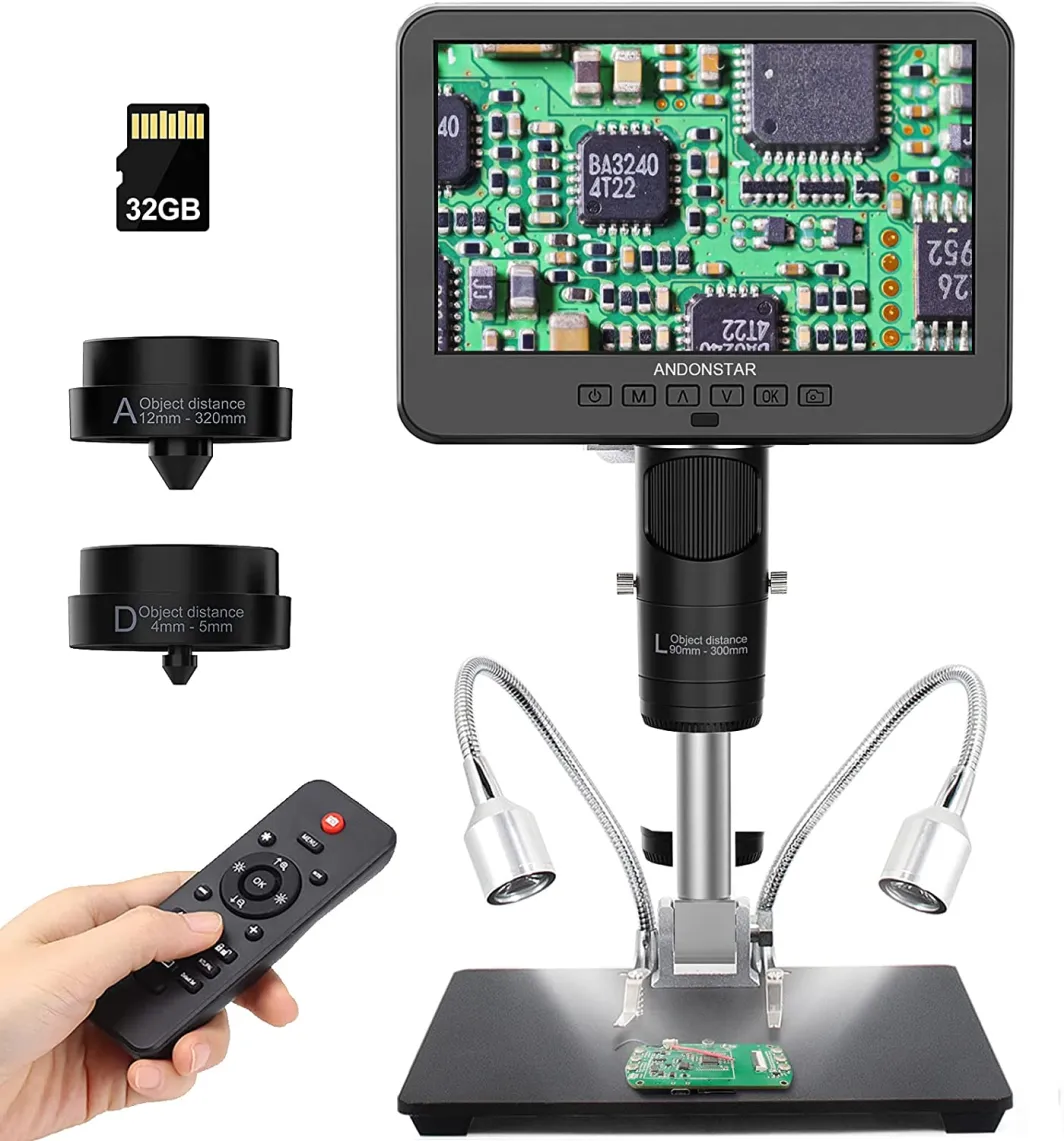
The Andonstar AD246S-M is a 7-inch HDMI digital microscope designed for hands-on inspection, recording, and specimen observation. It combines a built-in monitor with three interchangeable lenses, an adjustable metal stand, LED illumination, HDMI output, USB PC connectivity, and the ability to save captured images to a memory card.
Its three-lens design gives the microscope different working ranges for different tasks. Lens L is associated with electronics work, including circuit-board repair and soldering. Lens A is intended for objects such as coins, plants, rocks, insects, and precious stones, while Lens D is intended for high-magnification observation of biological slides.
The AD246S-M is commonly described as a 2000x microscope, but the manufacturer’s specification gives Lens D a range of 1800–2040x. That figure should not be treated as a universal optical-magnification standard. The product’s main appeal is its flexible digital viewing system: users can inspect material on the built-in screen, connect an external HDMI display, or connect to a Windows computer for additional software functions.
Key Features and Specifications
Three interchangeable lenses
The supplied lens set is the central feature of the Andonstar AD246S-M 3 lens digital microscope. Lens A provides a listed magnification range of 18–720x and a working or focus range of 12–320 mm. Lens D provides 1800–2040x with a short 4–5 mm working range, while Lens L provides 60–240x and a 90–300 mm working range.
These ranges are intended for different types of work rather than one continuous zoom system. The manufacturer associates Lens L with repairing or making circuit boards, Lens A with coins, plants, insects, rocks, and similar objects, and Lens D with high-magnification observation.
Display, recording, and connections
The microscope has a built-in 7-inch monitor. Its HDMI output can display the microscope feed on an external HDMI monitor while also displaying it on the built-in screen, according to the manufacturer’s variant-specific table. The unit also supports USB PC output and can save captured images to a memory card.
Maximum video resolution is listed as 2880×2160 UHD at 24 frames per second. Video is recorded in MP4 format, and the maximum listed frame rate is 120 fps. The manufacturer also describes Windows software with image-development, measurement, sharpness, edge-detection, and compositing functions.
Stand and illumination
The adjustable metal stand is listed at 20×18×30 cm, with a main bracket approximately 30 cm high. Its boom arm can be adjusted vertically and horizontally, while a secondary bracket provides further height and magnification adjustment. The movable slide holder includes clips and bottom lights, and the supplied dimmer cable is intended for illumination adjustment.
The listed package accessories include the microscope, metal stand, three lenses labeled A, D, and L, slide holder, remote, dimmer cable, HDMI cable, USB cable, slides kit, tweezers, and bug box. Storage-card inclusion is not treated as confirmed here because retrieved sources differ on whether a 32GB Micro-SD card is part of the package.
How It Works
The AD246S-M works as a camera-based digital microscope rather than a traditional eyepiece microscope. A selected lens is mounted to the microscope, the stand positions the lens over the subject, and the live image appears on the integrated 7-inch monitor. Focus and working distance depend on the lens being used, so switching from electronics inspection to slide observation requires changing the lens and repositioning the stand.
For circuit-board repair, Lens L is the relevant option identified by the manufacturer. Its 60–240x listed range and 90–300 mm working range are intended to provide room for electronics-related work. Lens A covers a broader set of everyday specimens and objects, while Lens D uses a much shorter 4–5 mm working range for high-magnification observation.
Controls and viewing options
The included remote allows users to operate functions without touching the monitor. A dimmer cable is provided for adjusting illumination, and the slide holder uses clips and bottom lights for supported slide-based viewing. The available lighting approach therefore covers both objects placed under the lens and slides that can benefit from illumination from below.
The microscope can be used independently through its built-in monitor, connected to an external HDMI display, or connected to a Windows PC through USB. The manufacturer says the Windows software includes measurement and image-processing tools, although the supplied research does not establish every supported operating-system version, software workflow, or measurement accuracy.
HDMI and USB cables are listed among the accessories.
Everyday Uses and Benefits
Soldering and circuit-board repair
The Andonstar AD246S-M digital microscope is specifically positioned for electronics work through Lens L. The lens is associated with repairing or making circuit boards, and its listed working range is 90–300 mm. That relatively long range is relevant when a user needs to inspect a board while retaining space around the subject.
The microscope can show the live view on its own screen, and the HDMI output provides another viewing option. The available recording functions may also be useful for documenting an inspection, although the supplied facts do not establish how long a card can record or the exact storage capacity supported.
Coins, plants, rocks, and insects
Lens A is the general-purpose option for objects such as coins, plants, rocks, insects, and precious stones. Its listed range of 18–720x and working range of 12–320 mm gives it a different role from the close-focus Lens D. The included tweezers, bug box, and slides kit also support basic specimen-handling and observation activities.
This makes the product relevant to hobbyists who want a screen-based way to inspect surface details rather than a conventional optical viewing system. However, the available information does not verify image quality for any particular object, so expectations should remain tied to the published features rather than assumed results.
Biological-slide observation
Lens D is identified for high-magnification biological-slide observation. Its listed magnification range is 1800–2040x, with a 4–5 mm working or focus range. That short range means the setup needs careful positioning and focusing compared with the longer-working-distance lenses.
The movable slide holder, clips, and bottom lights are relevant to this use. The product is suitable for people seeking digital observation of prepared or supported slides, but the supplied data does not establish that it is a laboratory-grade microscope or provide claims about specimen preparation, optical performance, or professional diagnostic use.
What Makes It Different
The main differentiator of the Andonstar AD246S-M 3 lens digital microscope is its combination of three purpose-oriented lenses and several display routes. Instead of presenting one lens as suitable for every task, the manufacturer assigns Lens L to electronics, Lens A to general objects and specimens, and Lens D to high-magnification slide observation.
The built-in 7-inch monitor also separates this model from a microscope that requires a separate computer or display for basic viewing. Users can inspect the live image directly on the unit, use HDMI for an external monitor, or use USB to connect to a Windows PC. The manufacturer’s software description adds measurement, sharpness, edge-detection, and compositing functions to the PC-connected workflow.
Another notable feature is the adjustable metal stand. The boom arm can move vertically and horizontally, and a secondary bracket provides additional height and magnification adjustment. This gives the system a more structured setup than a camera held over an object, although the supplied research does not verify the stand’s stability under every use condition.
The model should not be distinguished by treating “2000x” as a precise universal optical rating. The manufacturer lists Lens D as 1800–2040x, while marketing titles commonly round that capability to 2000x. The precise published range is the more appropriate description.
Setup and Practical Considerations
Stand and lens installation
Begin by assembling the listed metal stand and positioning the main bracket and boom arm over the intended work area. The manufacturer lists the stand at 20×18×30 cm, with a main bracket approximately 30 cm high. Because the three lenses have different working ranges, the stand height and microscope position need to be adjusted after selecting a lens.
Choose Lens L for electronics-related work, Lens A for coins, plants, rocks, insects, and similar objects, or Lens D for high-magnification biological-slide observation. Mount the selected lens, place the subject in the holder or on the work surface, and adjust the boom arm or secondary bracket until the image can be focused.
Connections and illumination
The product can be operated through its integrated 7-inch monitor. Connect the supplied HDMI cable when an external HDMI display is preferred, or connect the USB cable to a Windows PC for the manufacturer-described software functions. The exact computer requirements are not established by the supplied research, so users should verify current software compatibility before relying on a particular Windows setup.
Use the included dimmer cable to adjust illumination. For slide work, the movable holder, clips, and bottom lights provide the listed slide-support arrangement. The remote can be used to operate functions without touching the screen, which may help reduce movement during an inspection or recording.
Recording and storage
The manufacturer lists 2880×2160 UHD as the maximum video resolution at 24 fps, MP4 as the video format, and up to 120 fps as the maximum frame rate. The microscope supports saving captured images to a memory card. However, retrieved sources disagree about whether a 32GB Micro-SD card is included, so the exact seller package should be checked before purchase.
Advantages
Flexible task coverage
The three-lens arrangement gives the AD246S-M a clearly defined role across several activities. Lens L is specified for circuit-board and soldering work, Lens A covers everyday objects and specimens, and Lens D is intended for high-magnification biological slides. This is more adaptable than a setup built around only one of those use cases.
Self-contained viewing
A built-in 7-inch monitor means basic operation does not depend on an external display. The HDMI output adds the option of a larger or shared screen, while USB PC connectivity supports the manufacturer-described Windows measurement and image-processing functions.
Recording and documentation
The microscope supports onboard recording and image saving, with video listed at up to 2880×2160 UHD and MP4 format. This can be useful when an inspection needs to be documented or when an observation is easier to review later rather than only viewed live.
Adjustable physical setup
The metal stand, movable boom arm, secondary bracket, clips, and slide holder provide multiple positioning adjustments. The remote and dimmer cable also support hands-off operation and lighting control. These features are particularly relevant for users who need to keep a subject positioned while changing the view or recording it.
Limitations
Published specifications need careful interpretation
The product page combines the AD246S-M with the adjacent AD249S-M, which has a different screen size. Variant-specific details in this guide use the AD246S-M column or the separately titled 7-inch AD246S-M material. Buyers should confirm that a listing refers to the 7-inch AD246S-M rather than the related 10-inch model.
The “2000x” description is a rounded marketing term. The manufacturer lists Lens D at 1800–2040x, so it is more accurate to use that range than to present 2000x as a laboratory-standard optical measurement. The available data also does not establish the microscope’s practical resolution, image quality, or suitability for professional diagnosis.
Incomplete accessory and specification certainty
The manufacturer says captured images can be saved to a memory card, while a retrieved manual page lists a 32GB Micro-SD card as included. Because storage details are inconsistent, card inclusion should be verified with the exact seller package. Photo-resolution information is also inconsistent: the manufacturer lists 5600×2400 with interpolation, while another manual mirror gives a different figure.
No reliable retrieved source establishes a subscription requirement, warranty terms specific to ASIN B09VPPS96M, or a complete power-supply specification. Those details should be confirmed directly with the seller or current manufacturer documentation rather than assumed from the product title.
Who Should Consider Buying It
The Andonstar AD246S-M is best suited to hobbyists, makers, electronics repair users, educators, and specimen enthusiasts who want a digital microscope with its own screen and multiple lenses. Its published lens assignments make it particularly relevant to circuit-board repair, soldering, coin and rock inspection, plant and insect observation, and high-magnification slide viewing.
It may also suit users who value recording or computer-assisted inspection. HDMI output supports an external display, USB connectivity supports a Windows PC, and the manufacturer describes software tools for measurement, image development, sharpness, edge detection, and compositing.
The product is less clearly suited to buyers seeking a verified professional laboratory instrument, a conventional eyepiece experience, or guaranteed optical performance at the headline magnification. The supplied information does not provide laboratory certifications, diagnostic claims, tested image-quality results, or a complete power specification. Users with those requirements should verify the relevant details before purchase.
Frequently Asked Questions
What is the Andonstar AD246S-M?
It is a 7-inch HDMI digital microscope with three interchangeable lenses, an adjustable metal stand, LED illumination, onboard recording, HDMI output, USB PC connectivity, and Windows software functions described by the manufacturer.
What magnification does the microscope provide?
Lens A is listed at 18–720x, Lens D at 1800–2040x, and Lens L at 60–240x. The commonly used 2000x description is a rounded reference to Lens D rather than a separate verified optical standard.
Which lens is intended for soldering?
Lens L is the lens associated with electronics work such as repairing or making circuit boards. Its listed working or focus range is 90–300 mm.
Which lens is used for coins, plants, rocks, and insects?
Lens A is associated with coins, plants, insects, rocks, precious stones, and similar objects. It has a listed magnification range of 18–720x and a working range of 12–320 mm.
Is the microscope suitable for biological slides?
Lens D is identified for high-magnification biological-slide observation. Its listed range is 1800–2040x, with a 4–5 mm working or focus range, and the package includes a slide holder with clips and bottom lights.
Can it connect to a television or external monitor?
Yes. The manufacturer lists HDMI output, and the AD246S-M specification says the external HDMI monitor and the built-in microscope monitor can display the image.
Can it connect to a computer?
Yes. USB PC output is listed, and the manufacturer describes Windows software with image-development, measurement, sharpness, edge-detection, and compositing functions. Exact Windows version compatibility is not established in the supplied research.
Does it record video?
Yes. Maximum video resolution is listed as 2880×2160 UHD at 24 fps, video uses MP4 format, and the maximum listed frame rate is 120 fps.
Is a memory card included?
This is not confirmed consistently. The manufacturer says images can be saved to a memory card, while one retrieved manual page lists a 32GB Micro-SD card as included. Check the exact seller package before relying on card inclusion.
Does it include a stand and accessories?
The manufacturer lists a metal stand, three lenses, slide holder, remote, dimmer cable, HDMI cable, USB cable, slides kit, tweezers, and bug box. The exact contents can vary by seller listing, so the package description should be checked.
Final Verdict
The Andonstar AD246S-M is a versatile 7-inch digital microscope built around three task-specific lenses rather than one all-purpose magnification claim. Its strongest verified features are the Lens L electronics setup, Lens A general specimen range, Lens D slide-observation range, integrated monitor, HDMI and USB connectivity, adjustable metal stand, and recording support.
It is a practical candidate for hobby electronics, soldering, coins, rocks, plants, insects, and supported biological-slide observation. The product’s headline 2000x wording should be interpreted carefully, and buyers should verify variant identity, photo-resolution details, storage-card inclusion, Windows compatibility, warranty coverage, and power information before purchase.
Overall, the AD246S-M makes the most sense for users who want a flexible digital inspection station with screen viewing and multiple lenses. It should not be presented as a confirmed professional laboratory microscope, but its published feature set covers a broad range of educational, repair, and hobby observation tasks.
Ready to check this product? Review the current listing and seller details before deciding.
Check on Amazon →
As an Amazon Associate, WorthPeeks earns from qualifying purchases.