Product Overview
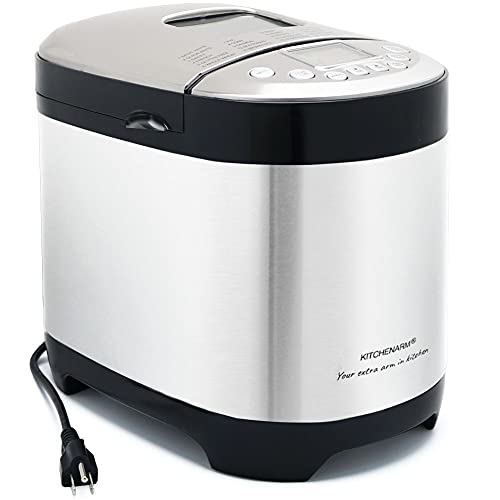
The KITCHENARM 29-in-1 SMART Bread Machine is a programmable bread maker designed for home users who want more control than a basic one-button appliance provides. It combines 29 automatic menus with three loaf sizes, three crust-color settings, delayed starting, keep-warm operation, and a customizable HOME MADE cycle. The machine is identified in the manufacturer’s quick guide as model KA8520, while the ASIN-indexed manual and third-party ASIN record identify the related product as model 85203.
The matching feature set supports treating these designations as related versions of the same KITCHENARM 29-in-1 bread machine, although the manufacturer does not clearly explain the model-number relationship on the retrieved official pages.
The appliance is aimed primarily at North American users. KITCHENARM describes it as a 120V, 60Hz appliance with a three-prong grounded plug, and the ASIN-indexed manual specifies a 110V–130V, 60Hz supply. It should not be assumed to work with electrical standards outside the United States and Canada; the manufacturer references a separate European 230V/50Hz version.
Its central appeal is flexibility. The automatic programs cover familiar bread styles such as Basic, Sweet, French, Whole Wheat, Multigrain, Dark Rye, Brioche, Ciabatta, Sourdough, Gluten Free, Salt Free, Sugar Free, and Keto. Additional menus extend beyond bread to include cake, jam, and yogurt.
Users who regularly adapt recipes can also use HOME MADE to set customized kneading, resting, rising, and baking stages rather than relying only on preset programs.
The machine supports 1 lb, 1.5 lb, and 2 lb loaf sizes, making it more adaptable to different household needs than a bread maker restricted to one batch size. A 2.5-inch LCD display provides the interface, while the included food-grade Teflon-coated nonstick bread pan contains the dough and supports the removable kneading blade. The manufacturer lists ETL certification for the US and Canadian markets, a two-year warranty, and lifetime customer service, including recipe customization support.
Key Features and Specifications
Automatic programs and baking choices
The headline feature is the set of 29 menus: 21 bread menus, seven non-bread menus, and one customizable HOME MADE menu. The bread selections cover everyday loaves as well as recipes that commonly require different ingredient ratios or handling, including gluten-free, whole-wheat, multigrain, dark rye, brioche, ciabatta, sourdough, salt-free, sugar-free, and keto options.
The non-bread programs make the appliance more than a dedicated loaf machine. The listed choices include cake, jam, and yogurt, although the available facts do not provide individual cooking times, temperatures, batch capacities, or recipe instructions for each program. Those details should therefore be taken from the applicable manual or recipe guidance rather than inferred from the menu names.
Loaf size and crust controls
The KITCHENARM bread maker can produce 1 lb, 1.5 lb, or 2 lb loaves. This lets a user select a smaller batch when bread will be consumed quickly or a larger loaf for a household that needs more servings. The appliance also offers Light, Medium, and Dark crust settings, allowing the exterior finish to be adjusted without changing the selected bread style.
Programmable timing and notifications
A 15-hour delay timer allows users to schedule a later completion time. The quick guide explains that the TIME plus and minus controls can be used to arrange bread for a later finish, which is useful for planning breakfast or having a loaf ready around a meal. The machine also provides a one-hour keep-warm period after a cycle, according to the manufacturer.
Two alerts are specifically identified: an ADD-NUTS alarm and a REMOVE-PADDLE alarm. These notifications address two common points in bread-machine preparation—adding ingredients at the appropriate stage and removing the kneading blade when the program calls for it. The exact timing of each alert can depend on the selected program and should be confirmed in the instructions.
Home Made customization
HOME MADE is the main feature for users who want to move beyond fixed programs. The manufacturer says it can store up to four personalized menus and lets users specify individual cycle times for kneading, resting, rising, and baking. Fermentation and baking temperatures can also be customized.
This does not mean every recipe will automatically work without adjustment. Bread-machine results depend on ingredients, hydration, yeast, flour type, room conditions, and the selected process. However, the ability to change stages gives experienced bakers a way to create repeatable procedures for recipes that do not fit the automatic menus.
Display, pan, and electrical details
A 2.5-inch LCD display provides the control interface. The bread pan is described as food-grade and Teflon-coated with a nonstick surface. The quick guide shows a removable kneading blade and explains that the pan is installed by positioning it counterclockwise, pressing it down, and turning it clockwise to lock it into the oven base.
The manufacturer states that the appliance is ETL certified for US and Canadian markets. It uses a grounded three-prong plug and is intended for 120V, 60Hz operation. The ASIN-indexed manual gives a compatible supply range of 110V–130V at 60Hz.
How It Works
The KITCHENARM 29-in-1 bread maker is designed around a relatively straightforward sequence: add ingredients to the bread pan, select a menu and loaf settings, adjust timing or crust preferences where available, and start the program. The machine then performs the programmed combination of kneading, resting, rising, and baking stages. For recipes that require a different process, the HOME MADE cycle provides manual control over those stages.
Loading and installing the pan
The quick guide references a provided measuring cup and demonstrates recipes including Hawaiian Sweet Bread and Sourdough Artisan Bread. Ingredient order and quantities should follow the relevant KITCHENARM recipe, because changing the sequence or proportions can affect mixing and rising. Once the ingredients are in the pan, the removable kneading blade must be fitted as instructed before the pan is installed.
To secure the pan, the quick guide directs users to position it counterclockwise, press it down, and turn it clockwise. This locking step is important because the pan must remain engaged with the drive mechanism while the machine kneads and bakes. The lid and control panel should be handled according to the manual rather than forced if the pan does not seat correctly.
Selecting a cycle
Users can choose from the automatic menu list, a loaf size, and a crust color when those options apply to the selected program. For example, a whole-wheat recipe can use the Whole Wheat menu, while a gluten-free recipe can use Gluten Free. The available data confirms the menu names but does not provide the exact duration or temperature for every program, so the displayed cycle time and recipe instructions remain the authority for a particular bake.
The delay timer uses the TIME plus and minus controls to schedule completion. Because delayed baking leaves ingredients in the pan for an extended period, users should follow the recipe’s suitability for delayed starting, particularly when perishable ingredients are involved. The documented one-hour keep-warm function can hold the finished product after baking, but keep-warm time is not a substitute for prompt cooling and storage.
Using HOME MADE
The HOME MADE cycle is intended for users who understand how a recipe should be processed. Up to four personalized menus can be created, with separate settings for kneading, resting, rising, and baking. Fermentation and baking temperatures may also be customized, giving users the ability to build a process around a specific dough rather than selecting the closest preset.
A practical approach is to change one variable at a time and record the settings that produce a good result. The manufacturer’s recipe support and lifetime customer service may be useful when adapting a recipe, but the supplied facts do not promise that every recipe will be individually validated or that custom settings guarantee a particular result.
Power interruptions and finishing
The manufacturer lists 15-minute power-interruption recovery. This is intended to preserve progress during a short interruption, although the available information does not specify exactly how the machine resumes each stage or what happens after an interruption longer than 15 minutes. After a completed cycle, the machine can keep the loaf warm for up to one hour according to the stated specifications.
Everyday Uses and Benefits
Everyday homemade bread
The most direct use is baking standard household loaves without separately mixing, proofing, and baking in an oven. The Basic, French, Sweet, and related bread programs provide preset starting points, while the three loaf sizes allow users to avoid making a larger loaf than they need. Crust options add another level of adjustment for people who prefer a lighter or more developed exterior.
The bread maker can also support recurring routines. A user can prepare ingredients in the evening and use the 15-hour delay timer to finish bread later, provided the chosen recipe is appropriate for delayed preparation. The one-hour keep-warm function may help with scheduling, although the loaf will still need to be removed and stored appropriately.
Gluten-free and specialty loaves
The dedicated Gluten Free menu makes this a relevant bread machine for households that bake without gluten. The machine also includes Whole Wheat, Multigrain, Dark Rye, Sourdough, Salt Free, Sugar Free, and Keto menus. These options do not eliminate the need to use suitable ingredients or verify recipe requirements, but they provide named programs rather than requiring every specialty loaf to be treated as a generic basic bread.
Users should distinguish between a gluten-free setting and a guarantee of allergen-free preparation. The available product information confirms the menu, not the absence of cross-contact from prior use or a dedicated manufacturing environment. Anyone with a medical need to avoid gluten should use appropriate ingredient, cleaning, and handling practices.
Recipe experimentation
HOME MADE is suited to bakers who want to adapt recipes or repeat a process that differs from the automatic cycles. The ability to adjust kneading, resting, rising, baking, fermentation, and baking temperatures is more useful for experimentation than a simple machine with only fixed programs. Four personalized menus provide a way to retain multiple procedures rather than rebuilding each one from scratch.
The manufacturer supplies a 77-recipe book and states that hundreds of additional recipes are available through the KitchenArm Recipe Cloud. These resources can give new users a starting point while also helping experienced users understand how the machine’s programs are intended to be used.
Beyond bread
Cake, jam, and yogurt programs broaden the appliance’s role in the kitchen. They may be useful for someone who wants one programmable appliance for several preparation tasks instead of a bread-only machine. The available evidence does not establish the capacity or recommended recipes for these programs, so expectations should be based on the manual and the manufacturer’s recipes rather than assuming that every batch size or technique is supported.
Small-batch or larger-batch flexibility
The 1 lb, 1.5 lb, and 2 lb settings can accommodate different consumption patterns. A smaller loaf may suit one or two people, while the 2 lb setting may be more practical for a larger household. Actual results depend on the recipe selected, and users should not assume that every menu supports all three sizes unless the instructions say so.
What Makes It Different
The KITCHENARM 29-in-1 bread maker stands out within its own feature set through the combination of broad menu coverage and user customization. Many of its programs are familiar bread-machine categories, but the inclusion of Gluten Free, Whole Wheat, specialty diet-oriented menus, cake, jam, and yogurt gives the appliance a wider stated scope than a machine limited to basic white and wheat cycles.
The HOME MADE cycle is the clearest differentiator. It supports up to four personalized menus and permits individual stage times plus fermentation and baking-temperature adjustments. That makes the product relevant to users who want a programmable bread maker for homemade recipes rather than only a preset appliance.
The combination of three loaf sizes, three crust colors, a 15-hour delay timer, keep-warm operation, and ingredient-related alerts also gives users several practical controls. The ADD-NUTS and REMOVE-PADDLE alarms are particularly tied to the bread-making process rather than being generic timer functions.
The documentation and support offer another useful distinction. KITCHENARM states that the machine includes a 77-recipe book, access to hundreds of recipes through its Recipe Cloud, a two-year warranty, and lifetime customer service that includes recipe customization support. These claims describe available resources and support policies; they should not be interpreted as a guarantee that every recipe or custom cycle will produce identical results.
Setup and Practical Considerations
Before the first loaf
Place the machine on a stable, heat-resistant surface near a suitable grounded outlet. The documented electrical requirement is North American 120V, 60Hz operation, with the ASIN-indexed manual specifying 110V–130V at 60Hz. Users outside the US and Canada should not assume compatibility, especially because the manufacturer identifies a separate European 230V/50Hz version.
Read the relevant recipe and program instructions before adding ingredients. The quick guide references a measuring cup and demonstrates specific recipes, but the exact contents of every retail shipment are not definitively established. The manufacturer’s product page confirms the nonstick bread pan, while accessory claims beyond the referenced measuring cup should be checked against the exact retailer listing or manufacturer support.
Fitting the pan and blade
Insert the removable kneading blade into the bread pan, then load the ingredients as directed by the selected recipe. Install the pan by positioning it counterclockwise, pressing it down, and turning it clockwise to lock it into the oven base. Do not use metal utensils or abrasive cleaners on the pan or blade because the instruction manual warns that the pan has a nonstick coating.
Choosing settings
Select the appropriate automatic program or create a HOME MADE cycle. If the chosen menu supports it, select 1 lb, 1.5 lb, or 2 lb and choose Light, Medium, or Dark crust. For scheduled baking, use the TIME plus and minus controls to set the desired completion time, taking care to use recipes that are suitable for delayed preparation.
After the cycle, use appropriate heat protection when removing the pan. The one-hour keep-warm function can hold the baked result, but the available specifications do not describe the exact temperature or how long the loaf should remain in the pan. Follow the manual for cooling, removal, and storage procedures.
Advantages
The strongest advantage is breadth without requiring the user to own separate appliances for every recipe category. The 29 menus cover standard and specialty breads, while cake, jam, and yogurt programs expand the possible uses. This makes the KITCHENARM 29-in-1 bread maker relevant to households looking for a multipurpose programmable bread machine.
The three loaf sizes are practical for changing household needs. Choosing between 1 lb, 1.5 lb, and 2 lb can reduce unnecessary leftovers or provide more bread when needed. Three crust settings provide a simple way to personalize the finished loaf without manually adjusting an oven.
HOME MADE adds meaningful control for experienced users. Separate settings for kneading, resting, rising, and baking, along with adjustable fermentation and baking temperatures, create more room for recipe development than a fixed-menu machine. Four saved custom menus can make repeated experiments more convenient.
The machine also includes useful scheduling and process features. A 15-hour delay timer supports planned completion, the one-hour keep-warm function can accommodate a short serving delay, and 15-minute power-interruption recovery offers some protection against brief outages. The ADD-NUTS and REMOVE-PADDLE alarms address specific bread-machine tasks.
Finally, the stated support package is helpful on paper. The 77-recipe book, Recipe Cloud access, two-year warranty, and lifetime customer service provide resources for learning and troubleshooting. ETL certification for US and Canadian markets is also documented by the manufacturer.
Limitations
The product’s many programs do not automatically guarantee that every recipe will be easy or successful. Specialty breads such as gluten-free, keto, sourdough, and whole-wheat loaves can behave differently from standard wheat dough, and users still need appropriate ingredients, measurements, and recipes. The available evidence does not include independent performance testing, so this guide cannot make claims about loaf texture, noise, speed, or consistency in actual use.
The machine is also not documented as globally compatible. Its stated electrical specifications are for North American operation, and compatibility with other voltages or outlet types should not be assumed. Buyers outside the US and Canada should verify the exact regional model before purchase.
Some product details remain unclear. Dimensions and weight are omitted because retrieved secondary manual records conflict, listing different measurements and weights. Those specifications should be confirmed from the physical packaging or a definitive manufacturer specification sheet rather than relying on inconsistent secondary records.
Package contents are not fully established for every retail shipment. The quick guide references a provided measuring cup, but additional accessory claims appear in an ASIN-indexed manual and may depend on the shipment or seller. Confirm the exact contents with the retailer or KITCHENARM before relying on a particular accessory.
Cleaning requires care because the pan has a nonstick coating. The manual identifies the bread pan and kneading paddle as hand-wash components and advises avoiding abrasive cleaners and metal utensils. The product data does not confirm whether either component is dishwasher-safe, so users should not assume that it is.
The 15-minute power-recovery feature has a limited stated duration. The available information does not explain how the appliance resumes every program after an interruption or how it behaves after a longer outage. Likewise, exact times and temperatures for all automatic menus are not provided in the verified product facts.
Who Should Consider Buying It
The KITCHENARM 29-in-1 SMART Bread Machine is best suited to home bakers who want a broad range of preset programs and the option to customize recipes later. It is especially relevant for people interested in gluten-free or whole-wheat bread, specialty bread styles, smaller or larger loaf sizes, and a bread maker with cake, jam, and yogurt programs.
It should also appeal to users who value planning. The 15-hour delay timer can help coordinate baking with breakfast or another meal, while the keep-warm function provides a short holding period after a cycle. The three loaf sizes make the machine more adaptable for individuals, couples, and larger households, although the appropriate size depends on the selected recipe.
Experienced bakers may get the most value from HOME MADE. Its editable stage times and temperature controls can support repeatable custom processes, provided the user is willing to learn how dough behaves and adjust recipes carefully. The recipe book, Recipe Cloud, and stated recipe-customization support can provide useful starting points.
This may be less suitable for shoppers who need confirmed dimensions and weight before purchasing, because those specifications are not reliable in the retrieved evidence. It is also not the right assumption for buyers outside North American electrical standards unless the regional version is verified. Anyone requiring guaranteed allergen separation should likewise evaluate cleaning and cross-contact practices independently.
Frequently Asked Questions
What is the KITCHENARM 29-in-1 SMART Bread Machine?
It is a programmable bread maker with 29 menus, including 21 bread menus, seven non-bread menus, and a customizable HOME MADE menu. It supports 1 lb, 1.5 lb, and 2 lb loaves and has Light, Medium, and Dark crust settings.
Does it have a gluten-free setting?
Yes. Gluten Free is one of the listed automatic menus. The setting does not by itself guarantee an allergen-free preparation environment, so users with medical dietary requirements should also consider ingredients, cleaning, and cross-contact controls.
What other bread programs are available?
Listed examples include Basic, Sweet, French, Whole Wheat, Dark Rye, Multigrain, Brioche, Ciabatta, Sourdough, Salt Free, Sugar Free, and Keto. The precise operation and compatibility of each recipe should be checked in the manual or KITCHENARM recipe materials.
Can the machine make foods other than bread?
The manufacturer lists Cake, Jam, and Yogurt among the non-bread programs. The verified information does not provide the capacity or detailed process for each one, so users should follow the corresponding instructions rather than infer batch limits.
What is the HOME MADE cycle?
HOME MADE is a customizable program that can store up to four personalized menus. It allows users to specify stages such as kneading, resting, rising, and baking, and the manufacturer also says fermentation and baking temperatures can be customized.
Can I schedule bread to finish later?
Yes. The machine has a 15-hour delay timer. The quick guide says the TIME plus and minus controls can schedule a later completion time, but users should ensure that the recipe and ingredients are appropriate for delayed preparation.
Does it keep bread warm after baking?
The manufacturer lists a one-hour keep-warm function. The available facts do not specify all temperature or handling details, so the manual should be followed for removing and storing the finished loaf.
What happens during a power interruption?
The manufacturer lists 15-minute power-interruption recovery. The supplied information does not fully explain how every program resumes or how the appliance responds to a longer interruption.
Is the bread pan removable?
Yes. The quick guide shows a removable bread pan and removable kneading blade. The pan locks into the oven base by positioning it counterclockwise, pressing it down, and turning it clockwise.
Is the pan dishwasher-safe?
That is not confirmed in the available product data. The ASIN-indexed manual lists the bread pan and kneading paddle as hand-wash components and advises avoiding abrasive cleaners and metal utensils because of the nonstick coating.
What are the electrical requirements?
The manufacturer describes the machine as a 120V, 60Hz appliance with a grounded three-prong plug for North American use. The ASIN-indexed manual specifies a 110V–130V, 60Hz supply. Compatibility outside the US and Canada should be verified rather than assumed.
What accessories are included?
The quick guide references a provided measuring cup. The complete standard package contents for every retail shipment are not definitively established, so buyers should confirm additional accessories with the exact seller or KITCHENARM.
Are the machine’s dimensions and weight known?
They are not reported here because retrieved secondary records conflict on both measurements and weight. The most reliable approach is to confirm these specifications from the product packaging or a definitive manufacturer specification sheet before purchase.
What warranty and support does KITCHENARM state?
The manufacturer lists a two-year warranty and lifetime customer service, including recipe customization support. The exact warranty terms and process should be confirmed with KITCHENARM or the retailer.
Final Verdict
The KITCHENARM 29-in-1 SMART Bread Machine is a feature-rich programmable bread maker whose strongest qualities are menu variety, adjustable loaf sizes, delayed scheduling, and the unusually flexible HOME MADE cycle. Its Gluten Free and Whole Wheat programs address common specialty-bread needs, while Cake, Jam, and Yogurt menus extend its use beyond conventional loaves.
It is most compelling for users willing to follow recipes and explore settings rather than simply press one button and expect identical results from every dough. HOME MADE can be valuable for repeatable experimentation, and the recipe book, Recipe Cloud, warranty, and stated lifetime support add practical guidance. The removable nonstick pan and process alerts also support the normal bread-machine workflow.
Prospective buyers should verify the regional electrical version, exact package contents, and physical dimensions before ordering. They should also treat the gluten-free menu as a program feature, not a guarantee of allergen-free preparation, and follow the hand-wash guidance for the nonstick pan and kneading paddle. With those qualifications, this KITCHENARM 29-in-1 bread maker is a versatile choice for North American home bakers who want both automatic convenience and meaningful recipe customization.
Ready to check this product? Review the current listing and seller details before deciding.
Check on Amazon →
As an Amazon Associate, WorthPeeks earns from qualifying purchases.