Product Overview
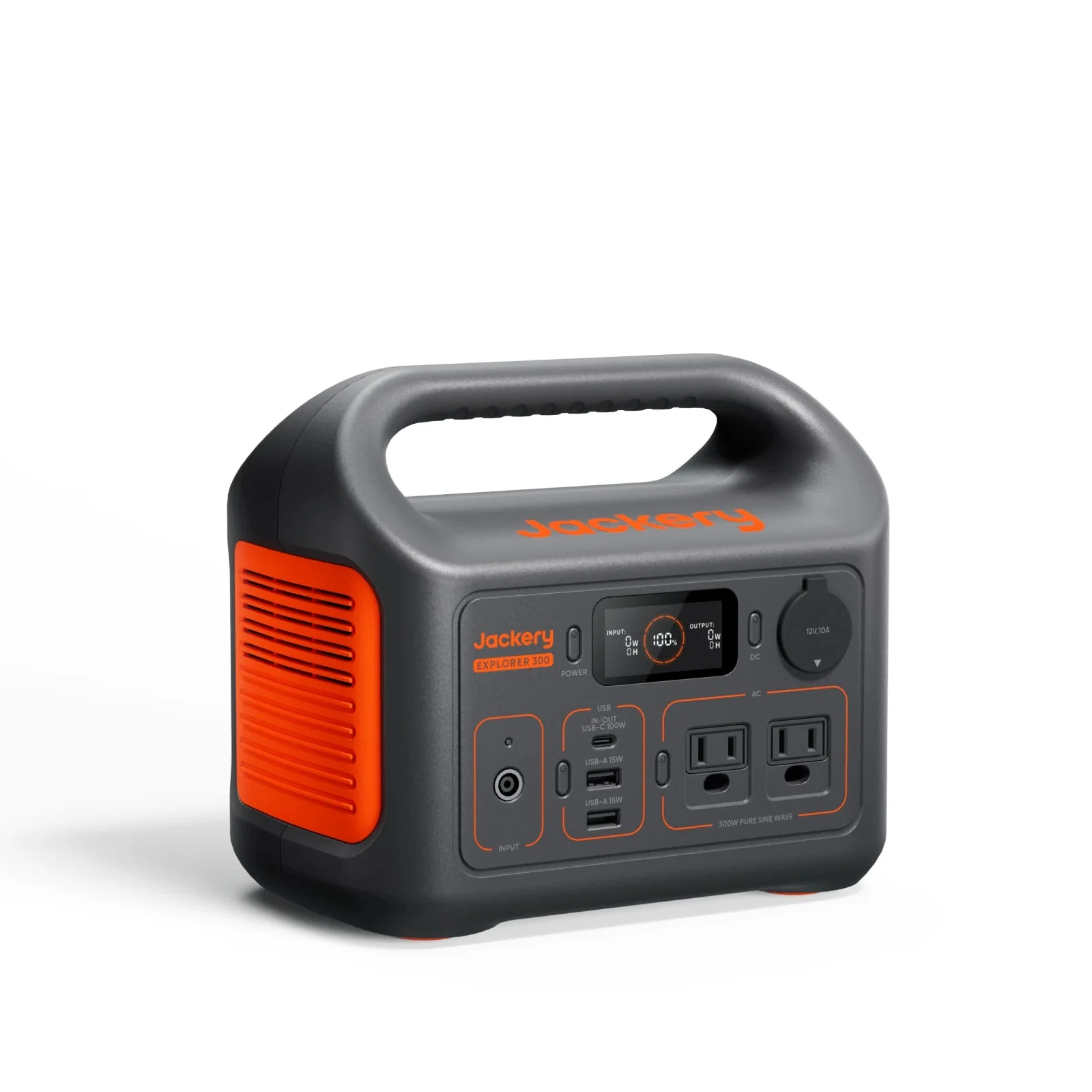
The Jackery Explorer 300 Portable Power Station is a compact battery-powered unit for outdoor use, travel, and limited backup power. The product is associated with ASIN B082TMBYR6, and manufacturer documentation describes a 300W pure-sine-wave AC system with two AC outlets, USB charging ports, a 12V car port, an LCD screen, and support for wall, car, and solar charging.
The supplied product name identifies this model as a 292Wh portable power station. However, Jackery’s retrieved sources list several capacity figures, including 292Wh, 293Wh, and 293.8Wh. The sources also differ on battery chemistry and some port specifications, so buyers should confirm the live listing and physical-unit details before purchasing.
Jackery positions the Explorer 300 as a portable power station that can support up to six connected devices. It is not a high-output whole-home backup system: its AC output is limited to 300W, and the manufacturer states that connected AC loads should remain below that limit.
Key Features and Specifications
Output and capacity
The Explorer 300 is rated for a maximum AC output of 300W, with a listed 500W maximum instantaneous output in Jackery’s support documentation. Its AC outlets use pure-sine-wave output, a feature intended to provide the type of alternating-current waveform required by many household and electronic devices. The supplied product name lists 292Wh, while Jackery sources identify the capacity as 292Wh, 293Wh, or 293.8Wh depending on the page or revision.
Ports and device support
Jackery documents two AC output ports, a 12V/10A car port, and three USB ports. The support page identifies one USB-A output at 5V/2.4A or 12W and a USB-C output rated up to 60W. The current product page instead describes a 100W USB-C PD port, two USB-A ports, and a 120W car port.
Because these details conflict, the exact port arrangement should be checked against the retailer listing for ASIN B082TMBYR6.
Display and construction
An LCD screen provides operating information, while the housing is listed as PC plus ABS high-strength plastic. The manufacturer describes support for up to six connected devices. The unit has dimensions of 23 × 13.3 × 19.9 cm and an approximate weight of 3.2 kg according to Jackery’s support page.
The Explorer 300 does not include app control or built-in LED lighting. It also lacks waterproofing and dustproofing according to the manufacturer’s support documentation.
How It Works
The Explorer 300 stores energy in its internal battery and supplies that energy through AC, USB, and 12V outputs. For household-style equipment, users can connect devices to either AC outlet, provided the combined AC demand stays below the manufacturer’s 300W limit. Exceeding the stated limit can cause the unit to shut off automatically.
The pure-sine-wave AC system makes this a general-purpose portable power station for compatible electronics, but the 300W rating still defines what it can run. The product data does not provide runtime figures for particular appliances, so expected operating time will depend on the device’s power draw, conversion losses, battery condition, and operating settings.
Recharging is available from a wall outlet, a car charger, or a compatible SolarSaga solar panel. Jackery lists approximate charging times of 4.5 hours through AC, five hours by car charger, and about 5.5 hours with a SolarSaga 100 panel. Only one solar panel is supported; Jackery says that connecting two or more panels is not supported because of voltage limitations.
Pass-through charging is supported, meaning the unit can charge while supplying power. Simultaneous solar-panel and car charging is not supported.
Everyday Uses and Benefits
Camping and outdoor activities
As an outdoor portable power station, the Explorer 300 can provide AC, USB, and 12V power away from a fixed outlet. Its compact dimensions and approximate 3.2 kg weight make it more practical for transport than larger power stations, although the product data does not establish a handle design or vehicle-storage requirements.
Travel and mobile work
The USB outputs can support compatible personal electronics, while the AC outlets provide a way to power devices that use standard plugs, subject to the 300W limit. The USB-C specification should be confirmed before relying on the unit for a particular laptop or high-power device because Jackery’s sources list different USB-C ratings for different apparent revisions.
Short-duration backup
The unit can serve as a backup portable power station for selected low-wattage equipment during a brief outage. It should not be treated as a whole-home generator or a replacement for a larger backup system. The available capacity, AC output limit, and lack of battery expansion restrict the scale of backup use.
What Makes It Different
The Explorer 300’s main appeal is its combination of a 300W pure-sine-wave AC inverter, two AC outlets, USB charging, a 12V car port, and three charging methods in a relatively compact enclosure. It also supports pass-through charging and one compatible SolarSaga panel, giving users several ways to replenish the battery depending on location.
The LCD screen provides local status information without requiring a phone application. Conversely, this is not an app-connected system: Jackery explicitly says the Explorer 300 does not support app control. It also cannot be expanded with additional batteries or operated in parallel with another unit.
The model’s specifications require extra care. The 292Wh name, 293Wh descriptive figure, and 293.8Wh support figure do not align perfectly, and battery chemistry is identified as NCM lithium-ion on one support page and LiFePO4 on the current product page. These discrepancies may reflect revisions, so they are an important part of evaluating this specific listing.
Setup and Practical Considerations
Initial preparation
Before using the Explorer 300, identify the exact configuration supplied with ASIN B082TMBYR6 and compare the physical ports with the current retailer and manufacturer information. The included items listed by Jackery are the power station, an AC charging cable and adapter assembly, a 7909 car-charger cable, and a user manual.
Charging the unit
The power station can be charged from a wall outlet, a car charger, or a compatible SolarSaga solar panel. Jackery lists approximate charging times of 4.5 hours by AC, five hours by car charger, and about 5.5 hours using a SolarSaga 100 panel. Solar input is limited to one panel, and solar and car charging cannot be used simultaneously.
Connecting equipment
Turn on the relevant output before connecting compatible equipment, and keep total AC demand below 300W. Use the LCD screen to check operating information. Follow the manual for cable selection, ventilation, and temperature conditions; Jackery lists charging temperatures of 0°C to 40°C and discharge temperatures of -10°C to 35°C.
Advantages
Useful output variety
Two AC outlets, USB outputs, and a 12V car port allow the Explorer 300 to serve several types of compatible equipment from one battery source. The pure-sine-wave AC output is a useful specification for users who need a conventional AC waveform, although compatibility and power demand still need to be checked for each device.
Flexible recharging
Wall, car, and SolarSaga charging give the unit more deployment options than a battery pack that can only use an outlet. Pass-through charging can also be useful when the power station is positioned between a charging source and connected devices.
Portable format
Jackery’s stated dimensions and approximate 3.2 kg weight support use in outdoor settings where a larger power station would be inconvenient. The LCD screen supplies local information without app dependence, which may suit users who prefer straightforward on-device controls.
Limitations
Output and expansion limits
The Explorer 300 is limited to 300W of AC output, and Jackery warns that exceeding the limit can make the unit shut off. The product data does not provide appliance-specific runtime estimates, so buyers should not assume that the listed watt-hour capacity translates directly into a fixed operating period.
Revision-sensitive specifications
Capacity information varies across the retrieved sources: the product name says 292Wh, Jackery’s current product page refers to 292Wh and 293Wh, and the support page lists 293.8Wh. Battery chemistry also differs, with NCM lithium-ion on the support page and LiFePO4 on the current product page. These details should be verified for the exact unit before purchase.
Port information is similarly inconsistent. One source lists a 60W USB-C output and a 12W USB-A output, while another lists a 100W USB-C PD port, two USB-A ports, and a 120W car port. Buyers should not choose the product for a specific charging speed without confirming the live listing or product labeling.
The unit has no app control, battery expansion, parallel operation, waterproofing, dustproofing, or built-in LED lighting. Only one solar panel is supported, and simultaneous solar and car charging is unavailable.
Who Should Consider Buying It
The Jackery Explorer 300 is best suited to buyers seeking a small outdoor portable power station for selected electronics, low-wattage AC equipment, and 12V accessories. It may fit camping, vehicle travel, mobile work, and limited emergency backup where portability and multiple charging methods matter more than high output or long-duration capacity.
It is less suitable for users who need whole-home backup, battery expansion, parallel operation, weather protection, app monitoring, or a built-in light. It may also be a poor fit for anyone who needs a confirmed high-output USB-C port or a precisely documented battery chemistry, because Jackery’s retrieved sources describe different revisions or specifications.
Before ordering, check the live listing associated with ASIN B082TMBYR6, confirm the included cables, and compare the displayed capacity and port layout with the equipment you plan to use.
Frequently Asked Questions
What is the Jackery Explorer 300’s capacity?
The supplied product name identifies it as 292Wh. Jackery’s retrieved sources also list 293Wh and 293.8Wh, so the exact capacity should be confirmed for the ASIN and revision being sold.
How much power can the Explorer 300 provide?
Jackery’s support documentation lists a maximum AC output of 300W and a 500W maximum instantaneous output. The manufacturer states that AC-connected devices should remain below 300W total.
Does it have pure-sine-wave AC output?
Yes. Jackery’s support documentation describes the Explorer 300 as having pure-sine-wave output, with two AC output ports.
How many devices can it support?
Jackery’s product page describes support for up to six connected devices. The actual combination depends on the available ports, power requirements, and the specific revision’s port configuration.
Can it charge from solar power?
Yes. It can charge with a compatible SolarSaga solar panel. Jackery lists about 5.5 hours with a SolarSaga 100 panel and says that only one panel should be connected.
Can solar and car charging be used at the same time?
No. Jackery’s support documentation says simultaneous solar-panel and car charging is not supported.
Does the Explorer 300 support pass-through charging?
Yes. The support documentation states that pass-through charging is supported, allowing the unit to charge while supplying power.
Does it have app control?
No. Jackery’s support page says the Explorer 300 does not support app control. It uses an onboard LCD screen for local information.
Is the Explorer 300 waterproof or dustproof?
No. Jackery’s support documentation says the Explorer 300 does not have waterproofing or dustproofing. Users should protect it from moisture, dirt, and unsuitable outdoor conditions.
What comes in the box?
Jackery lists the Explorer 300 power station, an AC charging cable and adapter assembly, a 7909 car-charger cable, and a user manual. Confirm the retailer’s current package contents before ordering.
Final Verdict
The Jackery Explorer 300 is a practical compact power station for users who need 300W pure-sine-wave AC output, USB charging, a 12V car port, and flexible wall, vehicle, or solar recharging. Its stated dimensions and approximate 3.2 kg weight support portable use, while the LCD screen and pass-through charging add convenience without requiring an app.
Its limitations are equally important. This is a low-output unit without expansion, parallel operation, weather protection, built-in lighting, or app control. More significantly, Jackery’s retrieved sources disagree about capacity, battery chemistry, and some port ratings.
Confirm the current ASIN listing and exact revision before purchase, especially if USB-C output, battery type, or a precise energy capacity is central to your decision.
Ready to check this product? Review the current listing and seller details before deciding.
Check on Amazon →
As an Amazon Associate, WorthPeeks earns from qualifying purchases.