Product Overview
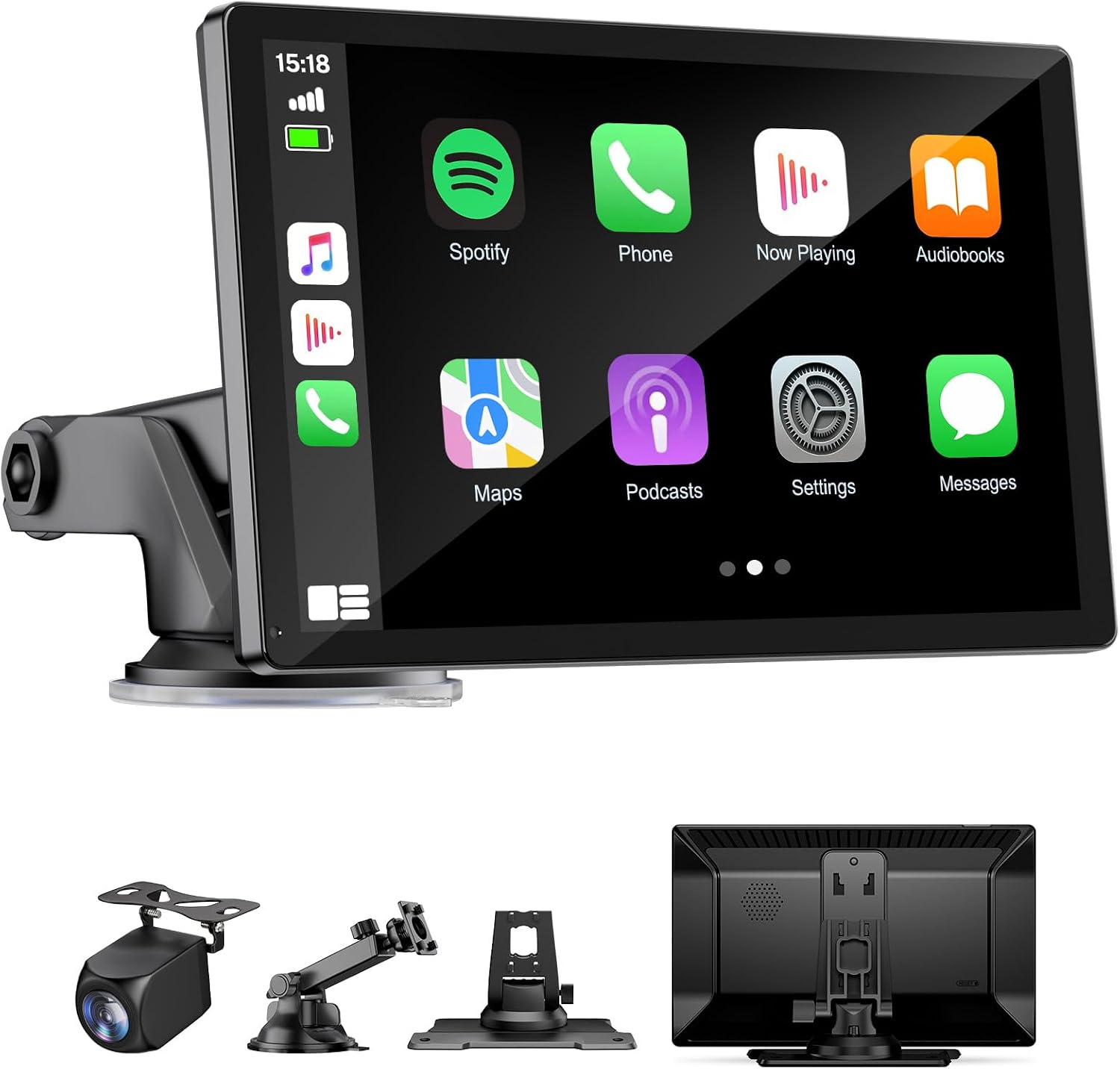
The HAUXIY Q9S is a portable 9-inch wireless Apple CarPlay and Android Auto display designed for drivers who want modern phone-based infotainment without replacing the vehicle’s factory radio. It mounts on the dashboard, receives power through the vehicle’s cigarette-lighter socket, and can preserve the existing center-console system.
The product is identified by ASIN B0FQTSRKBM and is documented in an ASIN-specific Q9S manual. Its core functions include wireless Apple CarPlay, wireless Android Auto, phone mirroring, voice control, GPS navigation through a connected phone, and several ways to send sound through the vehicle or the unit’s built-in speaker.
A wired rear-view camera is included. The camera is documented as having night vision, a 170-degree field of view, and 1080p video capture. It is intended to show the rear view when the vehicle is placed in reverse, but using that function requires routing the camera cable and connecting it to the vehicle’s reversing-light circuit.
This is therefore more than a simple wireless CarPlay adapter, but it is not a replacement head unit. The 9-inch screen supplies its own display and interface while relying on a compatible smartphone for CarPlay, Android Auto, navigation, calls, messages, music, and compatible voice assistants. The available documentation does not establish exact phone operating-system versions, subscription requirements, or compatibility with every vehicle, so those details should be checked before purchase.
Key Features and Specifications
9-inch touchscreen display
The Q9S uses a 9-inch LCD display with touch, app, and voice control. Its listed dimensions are approximately 8.8 inches wide, 5.4 inches high, and 0.8 inches deep. That gives the unit a substantial viewing surface for navigation and reversing-camera images while keeping it separate from the car’s original dashboard electronics.
Because the screen is dashboard-mounted, the driver can add a larger interface without removing the factory radio. The mounting approach also makes the unit potentially transferable between vehicles, although the product data does not specify how quickly or easily the mount can be moved in practice.
Wireless phone integration
Wireless Apple CarPlay and wireless Android Auto connect through Bluetooth and Wi-Fi. Once connected, the phone supplies access to supported navigation, calls, messages, music, and compatible voice assistants. This means the Q9S is primarily an interface for a connected phone rather than a self-contained navigation computer.
The screen also supports phone mirroring. For iPhone users, the manual describes this function as AirPlay; for Android phones, it is described as Android Cast. Mirroring is distinct from CarPlay or Android Auto because it reflects compatible phone content rather than presenting only the supported in-car interface.
Audio-output choices
The documented audio options are unusually flexible for a portable dashboard display. Sound can come from the screen’s built-in speaker, pass through FM transmission, travel over an AUX connection to the car, or connect by Bluetooth to the vehicle’s original speakers.
These alternatives matter because factory audio systems differ widely. A vehicle without a convenient AUX input may be able to use FM transmission or Bluetooth, while a vehicle with an AUX connection may use a direct wired path. The supplied data does not identify audio quality, FM frequency range, Bluetooth version, or supported codecs, so those technical details should not be assumed.
Backup camera and updates
The included backup camera is documented with night vision, a 170-degree field of view, and 1080p video capture. Its cable is listed as approximately 700 centimeters, or 7 meters, and retailer information describes it as suitable for sedans, trucks, vans, and pickup trucks. The camera is wired rather than wireless.
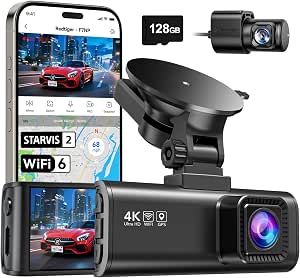
The display supports over-the-air firmware updates. The available sources confirm the OTA function but do not state the update schedule, storage requirements, software-support period, or whether updates change particular features. Some listings connected with similar HAUXIY products mention a front dash-camera function and 4K recording, but those claims are not treated as confirmed for this ASIN.
How It Works
Connecting a phone
For wireless Apple CarPlay or Android Auto, the phone communicates with the Q9S using Bluetooth and Wi-Fi. The phone remains the source of supported apps and services, while the screen provides the touch interface and presents the relevant driving-oriented content. Navigation therefore depends on the connected phone and its available mapping service rather than on a documented built-in GPS receiver.
The same principle applies to calls, messages, music, and voice assistants. The Q9S can display and control supported phone functions, but the product information does not establish whether every phone app is compatible. Drivers should expect compatibility to be governed by Apple CarPlay, Android Auto, the phone model, and the phone’s operating-system version as well as by the display itself.
Sending sound to the vehicle
After mounting the screen, the driver chooses an audio route. The built-in speaker is the simplest option and does not require a connection to the factory sound system. FM transmission can send the audio to a selected radio frequency, while the AUX cable provides a wired route when the car has a suitable input.
The manual also describes Bluetooth connection to the vehicle’s original speakers. The exact pairing process can vary by car, and the source material does not specify whether all factory Bluetooth systems support the required audio profile. Buyers should confirm that their vehicle’s audio system can accept the selected output method.
Installing the rear camera
The camera installation is more involved than the screen installation. The camera cable must be routed from the rear of the vehicle to the display, and the camera is intended to connect to the reversing-light circuit so the display can respond when reverse gear is engaged. The long cable may help with different vehicle sizes, but cable routing remains vehicle-specific.
The supplied documentation does not provide a vehicle-by-vehicle wiring guide or confirm whether extra wiring connectors, trim tools, or professional installation are needed. Anyone uncomfortable working near the reverse-light circuit should consider qualified installation. A camera image should not be treated as a substitute for mirrors, direct observation, or safe reversing practices.
Power and firmware
The Q9S uses a 12V-24V DC supply through the vehicle’s cigarette-lighter socket. This supports use in vehicles with the documented voltage range and avoids the center-console removal normally associated with a replacement head-unit installation. The sources do not specify cable length for the power lead, standby behavior, or whether the display can remain powered when the vehicle is off.
OTA firmware updates are supported through the screen’s software interface. The exact update procedure and network requirements should be confirmed in the supplied manual or on the unit because the retrieved evidence does not document the frequency or duration of updates.
Everyday Uses and Benefits
Older vehicles without factory CarPlay
The Q9S is aimed at drivers whose cars have a working radio but lack built-in Apple CarPlay or Android Auto. Since it adds its own display and connects through the cigarette-lighter socket, it can offer a route to phone-based navigation, calls, messaging, and music without replacing the original dashboard system.
This approach may be relevant when a vehicle’s factory head unit is difficult or expensive to remove, or when the owner wants to avoid changing the appearance of the center console. It does not turn the original radio into a CarPlay unit; instead, it places a separate interface on the dashboard and provides several ways to send its audio to the car.
Drivers wanting a portable display
A dashboard-mounted screen can suit owners who use more than one vehicle, provided they are willing to remount the device and reconnect power and audio as necessary. The included suction-cup mount and adhesive bracket provide two documented mounting approaches. The product data does not confirm how well either option performs on every dashboard material or in every temperature condition.
Portability can also be useful for a temporary upgrade. However, the rear camera is wired, so moving the display does not automatically make the entire system portable. A camera installation that has been routed through one vehicle may require separate work before it can be used elsewhere.
Vehicles needing a reversing-camera addition
The Q9S can be considered by drivers who want a display and a backup camera in one package. The camera’s documented night vision, 170-degree field of view, and 1080p capture specification provide a defined feature set for reverse viewing, while the long cable is intended to accommodate several vehicle types.
The camera is not a plug-in-only accessory in the strictest sense. It needs a physical cable route and a connection to the reversing-light circuit for automatic reverse activation. That makes the system more suitable for buyers prepared to perform wiring or arrange installation than for someone seeking a completely wireless camera.
Phone-centered navigation and entertainment
Because the Q9S uses a connected phone, it can provide access to familiar supported navigation, music, calls, and messages without asking the driver to learn a separate navigation platform. Voice control can reduce the need to use the touchscreen for certain supported tasks.
The display may also suit users who want phone mirroring through AirPlay or Android Cast. Mirroring can be useful for compatible content, but it should not be confused with unrestricted access to every phone app while driving. The product data does not define app-level restrictions beyond the documented mirroring and platform functions.
What Makes It Different
Factory-radio retention
The clearest distinction is the installation strategy. The Q9S is described as a plug-and-play, dashboard-mounted unit that can retain the original radio and use the cigarette-lighter socket. That makes it structurally different from an aftermarket head-unit replacement, which generally involves removing the existing center-console equipment; no specific competitor comparison is made here because compatibility and installation requirements vary by vehicle.
Retaining the factory radio can be valuable when the original system controls vehicle settings, integrates with existing functions, or is simply difficult to replace. The trade-off is that the Q9S remains a separate screen, so it does not create the same integrated appearance as a built-in system.
Multiple audio paths
The combination of built-in speaker, FM transmission, AUX, and Bluetooth gives the product more than one way to fit into a vehicle’s existing audio setup. This is useful because there is no single documented connection method that works for every car. Buyers can select the route that matches their factory radio and personal preferences.
The available evidence does not rank these methods by sound quality or reliability. FM transmission can depend on frequency conditions, while AUX requires a compatible input and Bluetooth depends on the vehicle’s pairing capabilities. The practical advantage is choice, not a promise that all four methods will perform identically.
Combined screen and camera package
The Q9S combines a wireless smartphone display with a wired backup camera and OTA update support. That combination can reduce the need to source a separate screen and camera, although package contents should still be checked with the seller because the research notes that retail bundles can vary.
The evidence is strongest for the 9-inch display and 1080p rear camera. References to an additional front camera or 4K recording appear in some related listings, but they are not confirmed for this exact ASIN and should not be used as purchase expectations.
Setup and Practical Considerations
Before mounting
Confirm that the vehicle provides a compatible 12V-24V cigarette-lighter socket and decide how sound will reach the car’s speakers. Check whether FM, AUX, or Bluetooth is the most practical route before fixing the display in place. Also choose a location that does not obstruct the driver’s view or interfere with controls; the available product data does not provide a vehicle-specific mounting diagram.
The listed package contents are the 9-inch screen, rear-view camera with a 700-centimeter cable, Type-C car charger, AUX cable, suction-cup mount, adhesive bracket, and user manual. Inspect the package before installation and verify that the retail bundle matches the listing.
Mounting and power
Attach the display using the suction-cup mount or adhesive bracket, then connect the Type-C car charger to the vehicle’s cigarette-lighter socket. The unit is designed to retain the factory radio, so the basic display installation does not require removing the center console. Positioning should prioritize a clear view and a secure fit.
The sources do not establish the adhesive’s long-term performance, the suction mount’s temperature tolerance, or a specific recommended viewing angle. Those factors can vary with dashboard texture, sunlight, and vehicle design.
Phone and audio setup
Pair the phone for wireless CarPlay or Android Auto using the Bluetooth and Wi-Fi connection process described in the manual. If wireless integration is not the intended mode, the product also documents AirPlay and Android Cast for phone mirroring. Then select built-in speaker, FM, AUX, or Bluetooth audio according to the vehicle’s equipment.
Camera wiring
Mount the rear camera at the back of the vehicle and route the cable toward the display. Connect the camera to the reversing-light circuit so the system can detect reverse operation as intended. Because routing and wiring differ between sedans, trucks, vans, and pickups, the included manual should be followed closely, and professional help may be appropriate.
The product information confirms the camera’s key specifications but does not give complete vehicle-specific wiring instructions. Do not assume that mounting the camera alone will activate the reverse-view function.
Advantages
Broad phone support
Wireless Apple CarPlay and wireless Android Auto make the Q9S relevant to households using different mobile platforms. The added AirPlay and Android Cast functions provide another way to mirror a compatible phone, while voice control can support hands-free interaction with supported services.
No factory-radio replacement
The dashboard format avoids the need to remove the existing head unit for the basic display installation. That can simplify the upgrade path for vehicles with unusual dashboards or factory systems that owners prefer to leave untouched. The benefit is practical rather than cosmetic: the new display remains visibly separate from the original radio.
Flexible audio integration
Built-in speaker, FM transmission, AUX, and Bluetooth output give owners several ways to connect the screen to the vehicle. This flexibility is particularly useful when the car’s factory audio system has limited inputs or when the owner wants to avoid a permanent wiring modification for the audio signal.
Included rear camera
A camera is included rather than treated as a separate optional accessory in the documented package list. Night vision, a 170-degree field of view, 1080p capture, and a roughly 7-meter cable are specified, giving buyers more concrete information than a generic “backup camera” description.
OTA update capability
Over-the-air firmware updates give the display a documented way to receive software updates without describing a need to replace the hardware. The available evidence does not promise a particular support lifespan, but the function is still useful for a product that depends on wireless phone integration.
Limitations
Installation is not entirely wireless
The display and phone connection are wireless in normal CarPlay or Android Auto use, but the backup camera is wired. Routing a cable through the vehicle and connecting to the reversing-light circuit can be a substantial installation task. The Q9S is therefore easier to install as a display-only system than as a complete display-and-camera system.
Phone dependence
The Q9S does not have documented standalone navigation or cellular service. Its navigation, calls, messages, music, voice assistants, and much of its smart functionality come from a connected phone. Drivers should account for phone battery, connectivity, app support, and operating-system compatibility.
Separate dashboard appearance
A portable screen adds functionality without replacing the factory radio, but it also creates an additional dashboard component. Some drivers may prefer this flexibility, while others may want an integrated appearance. The sources do not provide a design assessment, display brightness measurement, viewing-angle specification, or glare testing.
Compatibility details are incomplete
The retrieved research does not confirm exact supported phone operating-system versions, every vehicle’s wiring requirements, Bluetooth compatibility with all factory radios, or whether every retail package contains the same accessories. Buyers should verify these points with the current seller and manual before ordering.
Uncertain front-camera claims
Some related listings associate similar HAUXIY products with a front dash camera and 4K recording. The ASIN-specific manual primarily documents the 9-inch screen and 1080p backup camera, so a front-camera feature should be treated as unconfirmed for B0FQTSRKBM. It would be inaccurate to buy this product expecting a verified 4K front camera.
Who Should Consider Buying It
The HAUXIY Q9S is best suited to drivers who want to add a 9-inch wireless Apple CarPlay or Android Auto display while keeping the factory radio in place. It is especially relevant for older vehicles without built-in phone integration, owners who prefer a dashboard-mounted upgrade, and buyers who want a screen and rear camera in one documented package.
It may also fit households that use both iPhones and Android phones because the product supports both wireless CarPlay and wireless Android Auto, as well as the documented AirPlay and Android Cast mirroring modes. The multiple audio outputs make it more adaptable to vehicles with different factory-radio connections.
It is less suitable for someone seeking a completely wireless backup-camera installation, a hidden factory-style upgrade, or a self-contained navigation device. It also may not be the right choice for buyers unwilling to route a cable or connect wiring near the reversing-light circuit.
Before purchase, verify the current package contents, phone operating-system compatibility, vehicle-specific camera wiring, and preferred audio connection. The available research confirms the product identity and core functions, but it does not establish every compatibility detail or any subscription policy.
Frequently Asked Questions
What is the HAUXIY Q9S?
It is a portable 9-inch dashboard display identified by ASIN B0FQTSRKBM. It supports wireless Apple CarPlay, wireless Android Auto, phone mirroring, voice control, multiple audio-output methods, OTA firmware updates, and a wired rear-view camera.
Does it replace the factory radio?
No. It is designed to mount on the dashboard and retain the vehicle’s original radio. The screen uses the cigarette-lighter socket for power and can send audio through its built-in speaker, FM transmission, AUX, or Bluetooth, depending on the vehicle and chosen setup.
Does it include a backup camera?
The documented package contents include a rear-view camera with a cable listed at approximately 700 centimeters. The camera is described as having night vision, a 170-degree field of view, and 1080p video capture.
Is the backup camera wireless?
No. The camera is wired. Its cable must be routed through the vehicle, and the camera is intended to connect to the reversing-light circuit so the display can activate when reverse gear is engaged.
Does the screen provide navigation without a phone?
The product data describes navigation through a connected phone using Apple CarPlay or Android Auto. It does not document standalone navigation hardware or an independent navigation service.
How does audio reach the car’s speakers?
The documented options are FM transmission, AUX connection, or Bluetooth connection to the vehicle’s original speakers. The screen also has a built-in speaker. The best option depends on the equipment and pairing capabilities of the vehicle.
Can an iPhone and Android phone use the same screen?
The product supports wireless Apple CarPlay for compatible iPhones and wireless Android Auto for compatible Android phones. It also documents AirPlay mirroring for iPhone and Android Cast mirroring for Android devices.
Does it support firmware updates?
Yes. The Q9S is documented as supporting over-the-air firmware updates. The retrieved evidence does not specify the update schedule, support period, or exact update requirements.
Is a front 4K dash camera included?
That feature is not confirmed for this ASIN. Some related listings mention front-camera and 4K functions, but the ASIN-specific documentation primarily confirms the 9-inch display and 1080p rear camera.
Is a subscription required?
The research did not find a subscription requirement, but it also does not provide an explicit manufacturer subscription statement. Buyers should check the current seller information and manual if subscription terms are important.
Final Verdict
The HAUXIY Q9S offers a practical way to add wireless Apple CarPlay and Android Auto to a vehicle without replacing its factory radio. Its 9-inch touchscreen, phone mirroring, voice control, four documented audio paths, OTA update support, and included wired backup camera give it a broad feature set for a portable dashboard display.
Its main strength is flexibility: the screen can work with different factory-audio arrangements and can provide a modern phone interface through the car’s 12V-24V cigarette-lighter power. The rear camera adds value for buyers who also need reverse viewing, and the listed 7-meter cable is intended to cover a range of vehicle types.
The important qualification is installation. The display connection is relatively straightforward, but the backup camera requires cable routing and reversing-light wiring. The product also depends on a compatible phone for navigation and other connected functions, and several details—including exact operating-system compatibility, retail bundle consistency, and any front-camera capability—remain unverified.
Overall, this is a reasonable candidate for drivers seeking a portable 9-inch wireless CarPlay screen with a backup camera and factory-radio retention. It is best approached as a flexible aftermarket display rather than a fully integrated head-unit replacement, with vehicle-specific wiring and phone compatibility confirmed before purchase.
Ready to check this product? Review the current listing and seller details before deciding.
Check on Amazon →
As an Amazon Associate, WorthPeeks earns from qualifying purchases.